FlintTrade Desktop
FlintTrade is a self-hosted web app first. The backend serves the terminal and API from one origin, and a normal browser remains the primary supported way to run it. The desktop package is a small Electron 44 shell around that same local application.
Installer availability: the current source baseline is
v0.0.1. Previous Tauri and PyInstaller assets do not satisfy the Electron source-bootstrap contract. The public download surface distinguishes the source-built web-app install from Electron-shell installers. It withholds Electron commands and download buttons unless one release contains the complete asset set (four installers plusSHA256SUMS.txt). Use the source web-app setup or build the Electron shell locally whenever that complete set is unavailable.
Delivery model
An Electron release contains exactly four shell installers plus one checksum file:
| Platform | Canonical asset |
|---|---|
| macOS 13+, Apple Silicon and Intel | FlintTrade-<version>-mac-universal.dmg |
| Windows x64 | FlintTrade-<version>-win-x64.exe |
| Linux x64 | FlintTrade-<version>-linux-x64.AppImage |
| Linux ARM64 | FlintTrade-<version>-linux-arm64.AppImage |
| All platforms | SHA256SUMS.txt |
Electron 44 requires macOS 13 (Ventura) or later; macOS 12 (Monterey) is no longer supported by the desktop shell. See the Electron 44 release notes.
The macOS, Windows, Linux and tray assets are generated from the same canonical
FlintTrade angular F and green flint-spark mark used by the terminal and
public site.
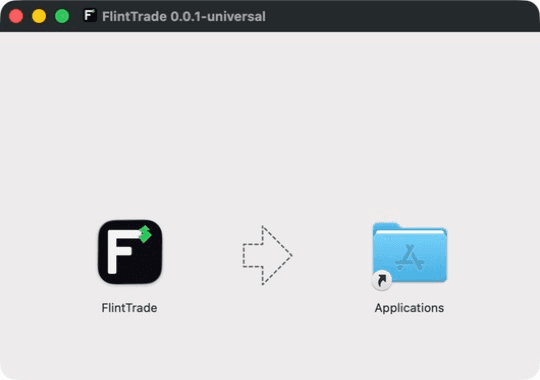
The installer contains Electron, the local splash, bootstrap resources and licence notices. It does not contain a frozen Python backend, a prebuilt terminal, or a separately downloaded runtime payload. The shell builds an inspectable source checkout on first launch.
The shell and application runtime therefore have separate update lifecycles:
- Source/runtime update: stage and build a sibling source checkout, health prove it against an isolated temporary workspace, drain the current backend, atomically promote the candidate, and retain one last-known-good checkout for rollback.
- Electron shell update: select a newer release on the current stable or
prerelease channel only when its canonical platform installer and
SHA256SUMS.txtare present, cryptographically verify the installer's GitHub Sigstore provenance against the exact public repository, tag and release workflow, and hand its attested name and digest to the packaged install script before the shell exits. The script re-hashes the downloaded bytes against that app-provided digest, so replacing the asset after attestation verification cannot change what is installed.
The app launches each shell installer from a unique owner-private directory under the shell profile. Failed, cancelled, pre-launch-failed and successful stages are all deliberately retained for forensic review. There is currently no automatic stage purge. Neither the app nor an exited installer treats a re-derived pathname as authority for recursive deletion after the original filesystem identity has been relinquished. Path replacements are therefore always preserved rather than treated as cleanup targets.
There is no payload feed, rolling updater release, renderer-owned manifest, or generic native-command bridge.
First launch
The Electron shell owns machine-level bootstrap and lifecycle work. On first launch it:
- acquires the application singleton and provisions the owner-only
master_passwordfile in the platform workspace; - resolves the managed source at
~/.flinttrade/src/FlintTradeand tools at~/.flinttrade/tools(under the current user's home on every platform); - acquires the official source with system Git, or uses the official HTTPS archive fallback when Git is unavailable;
- provisions checksum-verified pinned
uvand Node 22 distributions into the managed tools directory regardless of system Node availability;uvthen provisions Python 3.12 and Corepack activates the repository-pinned pnpm 10.34.5; - runs the frozen Python and JavaScript installs, then builds the terminal;
- promotes the completed candidate only after all build steps pass;
- starts
packaging/desktop_backend.pyfrom the managed virtual environment and waits for bothFLINTTRADE_BACKEND_READY port=<n>and a successful loopback/api/v1/pingbefore opening the main window.
Bootstrap progress is available as pushed events and a polled snapshot. The splash keeps a visible heartbeat during long work, redacts durable logs, and offers bounded retry or cancellation after failure. A partially built candidate never replaces the active source.
The application source and user data are separate:
| Platform | User workspace |
|---|---|
| macOS | ~/Library/Application Support/flinttrade/ |
| Windows | %APPDATA%\flinttrade\ |
| Linux | ~/.flinttrade/ |
FLINTTRADE_WORKSPACE_DIR and FLINTTRADE_HOME remain explicit advanced
overrides. Source promotion, rollback, shell update and ordinary uninstall do
not mutate the workspace.
Desktop lifecycle
- Closing the main window hides it to the system tray; it does not stop the backend.
- The tray exposes Show and Quit, and a tray click toggles visibility.
CommandOrControl+Shift+Ftoggles the window globally.- macOS dock activation restores a hidden window.
- Backend lines in the form
FLINTTRADE_NOTIFY\t<title>\t<body>become native notifications after strict parsing. - Explicit quit starts the backend's bounded asynchronous drain. Electron requests graceful shutdown first and then closes the owned process containment if proof does not arrive.
- A crashed backend replaces the remote terminal with the local recovery surface instead of leaving a stale page.
The main window loads only the backend's selected 127.0.0.1 origin. Electron
uses context isolation, renderer sandboxing and no Node integration. The
preload exposes named window.flintDesktop methods only; every IPC handler
validates the sender frame, and navigation, downloads, webviews, permissions
and unexpected child windows are denied.
Install after an Electron release is available
The public download surface
distinguishes the source-built web-app install from Electron-shell installers.
It exposes the supported one-command Electron paths only when one release
contains all four canonical installers plus SHA256SUMS.txt:
# macOS or Linux
curl -fsSL https://flinttrade.vercel.app/install.sh | bash# Windows 10/11
irm https://flinttrade.vercel.app/install.ps1 | iexThe scripts enumerate official GitHub releases, require an internally
consistent semantic-version channel, verify that the current platform's exact
canonical asset and SHA256SUMS.txt are both present, and verify the downloaded
installer before changing the installed shell. An in-app update additionally
requires GitHub's Sigstore artifact attestation; a direct first install remains
usable with the release checksum because no trusted FlintTrade app exists yet
to perform that provenance check. --ref <tag> selects an exact
release and fails closed when that release is incomplete. --no-launch skips
the final launch. --build-from-source / -BuildFromSource is a separate
contributor path that packages only the shell from a trusted checkout. That
path also compiles the packaged native filesystem boundary: macOS requires the
system /usr/bin/clang and Node's installed N-API headers, Linux requires
/usr/bin/cc plus those headers, and Windows requires the x64 .NET Framework
csc.exe. The installer checks these prerequisites before changing a checkout.
The install scripts record exact shell identity in owner-private local state. Updates and ordinary uninstalls refuse unknown same-name applications, links, reparse aliases, changed executables or integration files that are not proved by that receipt.
If the download site returns an error
Use this whenever an install command above fails. The hosted URLs are only a
convenience redirect to the scripts in this repository, and a deployment
without an immutable source commit answers 503 for all four routes rather
than redirecting. Fetch the same installer straight from GitHub:
# macOS or Linux
curl -fsSL https://raw.githubusercontent.com/navaneeshnagarajan/FlintTrade/main/scripts/install/flinttrade-install.sh | bash# Windows
irm https://raw.githubusercontent.com/navaneeshnagarajan/FlintTrade/main/scripts/install/flinttrade-install.ps1 | iexOr run the same file from a clone — see scripts/install/:
# macOS or Linux
bash scripts/install/flinttrade-install.sh# Windows
powershell -ExecutionPolicy Bypass -File scripts\install\flinttrade-install.ps1Every flag documented above (--ref, --no-launch, --build-from-source, and
their PowerShell spellings) works identically on this path — but note that
curl … | bash and irm … | iex give the script no argument vector. To pass a
flag, use bash -s -- (for example
curl -fsSL <url> | bash -s -- --ref v1.2.3), the scriptblock form on Windows
(& ([scriptblock]::Create((irm <url>))) -Ref v1.2.3), or run the file from a
clone as shown above.
macOS boundary
Local make desktop-package and pack:mac builds always force an ad-hoc
seal: codesign --verify --deep --strict proves bundle integrity, but the app
has no Developer ID trust and is not notarised. A manually downloaded local
build can therefore be blocked by Gatekeeper and may require the Privacy &
Security override. Do not describe an ad-hoc seal as Apple signing.
Only the release workflow can use distribution signing and notarisation. When all distribution-signing secrets are present, CI requires the complete notarisation trio too; without those complete sets it produces an ad-hoc-sealed DMG, and partial configuration fails the release instead of publishing an ambiguously signed build.
Windows boundary
The Windows asset is an Electron-builder NSIS x64 installer and installs per user. Windows 11 on ARM uses x64 emulation. Electron includes Chromium, so the shell does not download or depend on the retired WebView2-based desktop runtime. Authenticode signing is not currently configured.
Source apply and rollback use a packaged native filesystem helper rather than
claiming a Node directory-flush guarantee. The helper binds every managed
directory to its Windows volume serial and 128-bit file ID, rejects reparse or
aliased paths, and commits same-volume journal and promotion renames through
exact no-delete-share handles plus a native parent-directory flush. Journal
replacement and removal bind the target to its expected file ID and SHA-256
digest, deny compatible writers while that evidence is authenticated, and
require the reserved .previous name to be absent. A normal commit may use
that name transiently for the already-pinned target, but deletes it through the
same handle only after verifying the replacement. Before inspecting or mutating
the logical journal, the helper reconciles only an exact canonical transaction
receipt whose recorded target, temporary replacement, prior identity and
replacement identity match the files still present. This lets a crash after
.previous was published finish or roll back deterministically. A .previous
without that complete receipt-bound evidence, an invalid or changed fixed
.transaction receipt, or an ambiguous target/previous/temporary state is
preserved and blocks mutation instead of being adopted as cleanup authority.
Windows source cleanup pins the managed parent, renames the exact identity-bound root to its deterministic quarantine and flushes the parent before reclamation. The packaged helper then snapshots every direct child by native file ID, reopens that exact identity without following reparse points, and deletes only handles whose canonical parent remains inside the pinned quarantine. A reparse entry itself may be removed, but its external target is never traversed. Late, changed, locked, over-budget or ambiguous evidence leaves the exact quarantine in place rather than widening deletion authority.
The managed target is absent while retained evidence is tracked in
.flinttrade-source-cleanup.json or
.flinttrade-preserved-source-quarantines.json. Startup and the next source
apply retry entries in the source-cleanup inventory; a successful native
reclamation prunes its row, so ordinary failed candidates and staging roots do
not accumulate until the metadata cap denies future updates. Preserved
last-known-good promotion evidence remains manual-forensics evidence: recovery
only proves an already removed quarantine absent before pruning that inventory.
Each inventory remains independently capped at 64 entries as an integrity
bound. Evidence which stays locked or changes identity may still require the
documented manual archive-and-remove procedure. A changed identity or ambiguous
target/quarantine arrangement is never adopted as deletion authority.
The helper executable is SHA-256-bound into the Electron main bundle at build
time. The Windows Job supervisor opens and hashes that exact ordinary file,
denies write/delete sharing, and retains the handle through CreateProcess so
the verified helper cannot be replaced between authentication and execution.
Linux boundary
Linux publishes separate x64 and ARM64 AppImages. The install script uses a
per-user destination, desktop entry and command wrapper without sudo. If
FUSE 2 is unavailable, it attempts an installer-owned AppImage extraction and
runs the extracted AppRun instead.
Uninstall
After an Electron release is installed with the one-command installer, ordinary uninstall removes only the identity-proved shell and the integration files named by that installer's receipt:
# macOS or Linux
curl -fsSL https://flinttrade.vercel.app/uninstall.sh | bash# Windows
irm https://flinttrade.vercel.app/uninstall.ps1 | iexThe workspace, Electron profile, managed source and tools, and legacy desktop data are retained so a reinstall can recover them. The uninstaller refuses to delete a same-name path without the exact receipt and executable/integration identity.
A manual macOS Finder copy from the DMG deliberately has no installer receipt.
Quit FlintTrade and move that FlintTrade.app to Trash in Finder; the workspace,
Electron profile, managed source and tools remain available for reinstall. Once
the unreceipted app is gone, the purge command below can still remove recognised
FlintTrade data. The script will not claim an unreceipted same-name application
as its deletion authority.
--purge on macOS/Linux, or -Purge on Windows, additionally requests deletion
of recognised FlintTrade data. Purge is irreversible, requires typed or
explicit scripted confirmation, stays within the current user's home and
fails closed on links, reparse points, foreign ownership or an unproved custom
workspace:
# macOS or Linux
curl -fsSL https://flinttrade.vercel.app/uninstall.sh | bash -s -- --purge# Windows
& ([scriptblock]::Create((irm https://flinttrade.vercel.app/uninstall.ps1))) -PurgeIf the download site returns an error
The hosted URLs are only a convenience redirect to the scripts in this
repository. If https://flinttrade.vercel.app/uninstall.sh or
https://flinttrade.vercel.app/uninstall.ps1 returns an error, fetch the same
uninstaller straight from GitHub:
# macOS or Linux
curl -fsSL https://raw.githubusercontent.com/navaneeshnagarajan/FlintTrade/main/scripts/install/flinttrade-uninstall.sh | bash# Windows
irm https://raw.githubusercontent.com/navaneeshnagarajan/FlintTrade/main/scripts/install/flinttrade-uninstall.ps1 | iexOr run the same uninstaller directly from a clone (or from the managed source
checkout at ~/.flinttrade/src/FlintTrade):
# macOS or Linux
bash scripts/install/flinttrade-uninstall.sh# Windows
powershell -ExecutionPolicy Bypass -File scripts\install\flinttrade-uninstall.ps1Both accept the same --purge / -Purge flag. These are the same files the
site serves — see scripts/install/.
Build and verify locally
Shell development requires Git and Node 22.22.2 or newer. Use the repository's
pinned pnpm 10.34.5; Rust is needed only for the optional core/ticks package,
not for Electron packaging.
These lines run unchanged in bash, zsh and Windows PowerShell:
pnpm install --frozen-lockfile
python scripts/ft.py desktop-test     # Electron TypeScript + Vitest
python scripts/ft.py desktop-build    # verify resources, test, and bundle main/preload
python scripts/ft.py desktop-package  # package and verify this host's installer
On POSIX, make desktop-test, make desktop-build and make desktop-package
are aliases for the same three targets.
Installer output lands in packages/apps/desktop/release/electron/.
Package-specific commands are also available:
pnpm --filter @flinttrade/desktop typecheck
pnpm --filter @flinttrade/desktop test:electron
pnpm --filter @flinttrade/desktop bundle
pnpm --filter @flinttrade/desktop pack:mac
pnpm --filter @flinttrade/desktop pack:win
pnpm --filter @flinttrade/desktop pack:linux:x64
pnpm --filter @flinttrade/desktop pack:linux:arm64
Only the command matching the host platform is expected to work locally. A Mac package does not prove Windows or Linux runtime behaviour. The local macOS command always uses the ad-hoc seal; Apple distribution signing and notarisation are release-CI-only paths.
Release CI
.github/workflows/desktop-release.yml is the release authority. Release
Please dispatches it from the immutable version tag and expected commit SHA, or
a maintainer can dispatch it without a tag for build-only artefacts. The matrix
runs:
- macOS universal on
macos-14; - Windows x64 on
windows-latest; - Linux x64 on
ubuntu-22.04; - Linux ARM64 on
ubuntu-22.04-arm.
The two Linux legs stay on 22.04 deliberately, and are the one place in CI
exempt from the supported-runner floor in flint.toml. They compile the
native addon that ships inside the installer, so the runner's glibc becomes
the minimum glibc of the published binary — raising the runner would raise
the floor for every user. The jobs that compile nothing (validate,
publish, electron-desktop-tests) track the supported floor instead.
Each job installs the frozen JavaScript workspace, verifies the bootstrap tool
manifest, bundles Electron, builds the installer and verifies the packaged
security contract. Publication refuses an existing non-empty release, creates
SHA256SUMS.txt, attests each asset's provenance, and rechecks the exact
five-asset set. The in-app updater fetches attestations by exact installer
digest and requires the desktop-release.yml workflow_dispatch identity at
the selected tag, GitHub's public Fulcio issuer, and valid Rekor and certificate
transparency proofs before installer handoff.
test.yml runs the Electron TypeScript, Vitest, bundle and hardened Linux
directory-package gate on normal code changes. The weekly/manual
nightly-cross-platform.yml packages Electron on macOS, Windows and Linux.
Windows and Linux runtime semantics remain CI/contributor-owned evidence; a
single local Mac run is not cross-platform proof.
Relevant source
| Path | Role |
|---|---|
packages/apps/desktop/electron/ | Electron main/preload, bootstrap, updates, lifecycle and tests |
packages/apps/desktop/splash/ | Local bootstrap/recovery surface |
packages/apps/desktop/resources/bootstrap/ | Packaged bootstrap entrypoints and verified tool manifest |
packaging/desktop_backend.py | Source guardian and backend process owner |
scripts/install/ | Identity-bound shell install and uninstall scripts |
.github/workflows/desktop-release.yml | Four-installer build and publication |
Troubleshooting
- The download page does not show Electron install commands or downloads.
This is expected unless one release contains all four canonical installers
plus
SHA256SUMS.txt. Use the distinct source-built web-app setup or build the Electron shell locally when the complete set is unavailable. - First launch remains on the splash. Read the redacted bootstrap log in
the workspace's
logs/directory. Retry resumes through a new attempt; a failed candidate does not replace the active source. FlintTrade durably caps first-run allocation at three retained attempts (the initial attempt plus two retries) and stops before allocating another candidate, download, snapshot or extraction tree. The app never pathname-deletes this forensic evidence; use the explicit uninstall purge flow if all three attempts fail. - A source update is refused. The updater rejects dirty, foreign or changed active checkouts. Keep personal source work outside the managed active path. On Windows, close programs holding files in the managed checkout and retry; FlintTrade preserves the journal instead of deleting around a lock. A filesystem which refuses the native parent flush is unsupported and the update remains fail-closed.
- Windows reports too many preserved source-operation lease quarantines.
These are
.flinttrade-bootstrap-operation.lock.stale-*directories left by interrupted bootstrap or update ownership, not either source-cleanup inventory. FlintTrade revalidates them but does not pathname-delete them on Windows, and blocks after 64 are retained. Stop FlintTrade, archive the exact directories for diagnosis, then remove only confirmed stale quarantine directories; never remove the active.flinttrade-bootstrap-operation.lock. - macOS reports an unidentified developer. The current boundary is an ad-hoc seal, not Developer ID signing or notarisation. Use the documented Privacy & Security override for a locally built package.
- Linux cannot mount the AppImage. Use the one-command installer after a release is available; it attempts the FUSE-less extracted layout.
- Port 5100 is already in use. The desktop guardian starts the managed
backend with
--port 0, so a contributor backend on 5100 does not conflict.